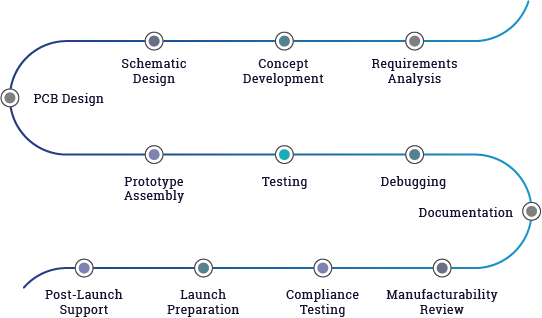
Hardware Engineering 🔹Overview Focuses on design, development, and maintenance of physical electronic components and systems. Involves microprocessors, circuit boards, sensors, and electronic devices. Ensures designs meet performance, safety, and application-specific requirements. Works in close collaboration with software engineering for seamless system integration. 🔹Role in Medical Services Essential for highly reliable, precise, and compliant healthcare technologies. Applied in diagnostic equipment, imaging systems, implantable devices, and wearables. Prioritizes high performance, low power consumption, and seamless AI/IoT/cloud integration. Ensures devices meet stringent regulatory and safety standards. 🔹Hardware Engineering Expertise End-to-End Hardware Design: From concept to production-ready solutions. PCB Design & Development: High-performance, compact, and optimized layouts. Sensor Integration: Biomedical sensors for accurate patient monitoring and diagnostics. Signal Processing: Noise reduction, data accuracy, and reliable output handling. Power Optimization: Energy-efficient designs for portable and wearable devices. System Integration: Hardware–software co-design for smooth operation. Regulatory Compliance: Adherence to FDA, IEC 60601, ISO 13485, ISO 14971, HIPAA, MDR standards. Process Flow Diagram Key Offerings Concept development and Simulation Circuit Designing and Schematic drafting Prototype development and evaluation Component selection and benchmarking Bill of Material optimization Obsolescence management (Design Controlled) PCB Design Functional Testing, Stress Testing Compliance Testing FMEA, DFM, DFT analysis Production transfer